TL;DR
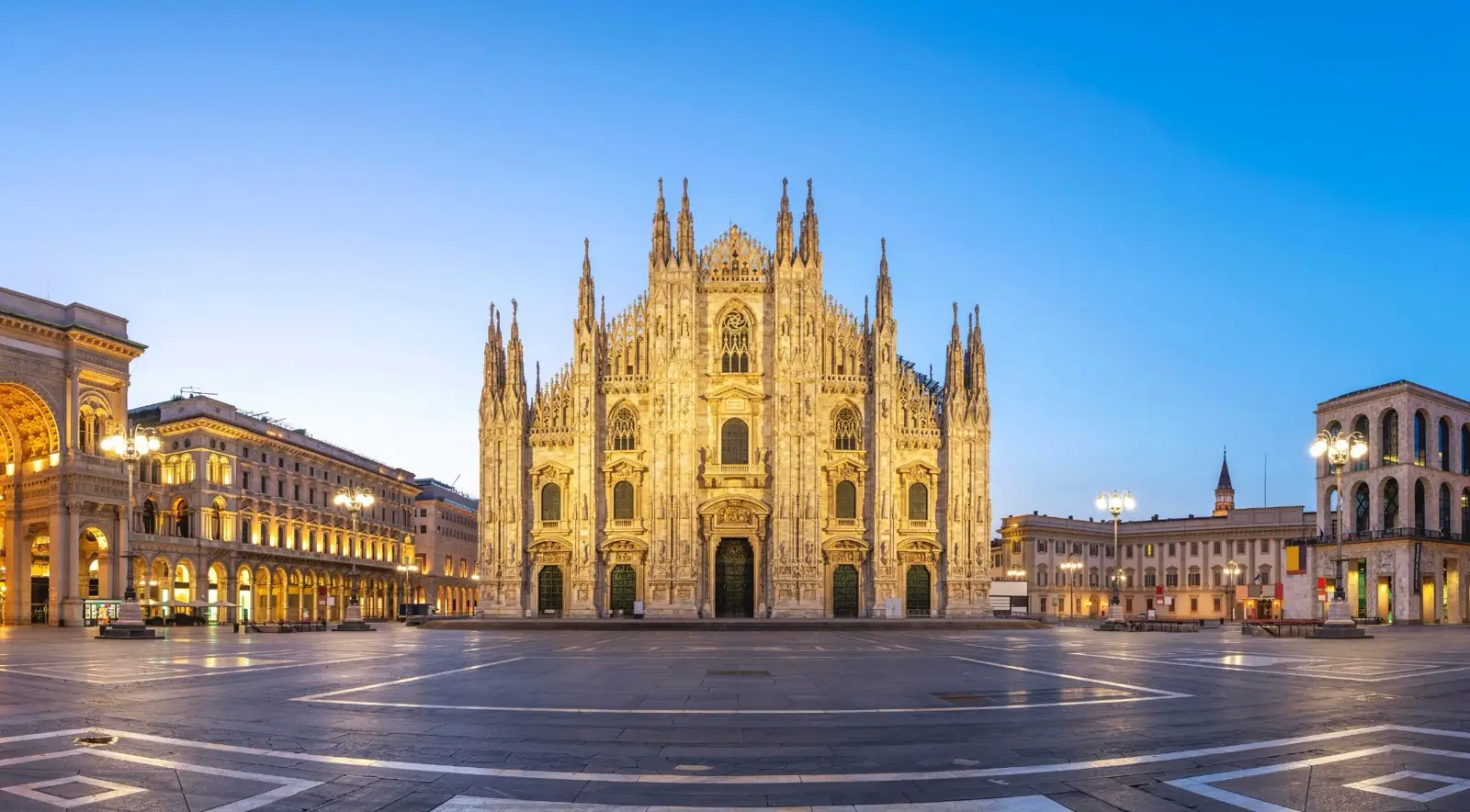
Piazza del Duomo is the monumental main square at the exact centre of Milan — the city's civic, geographic and transport heart — dominated by the Duomo and framed by grand arcaded palaces, the Galleria, and the equestrian monument to King Victor Emmanuel II. It is free and always open, a natural starting point for exploring the city, and ringed by landmarks: the cathedral, the Galleria Vittorio Emanuele II, the Royal Palace (Palazzo Reale), the Museo del Novecento, and, a short walk away, La Scala and Sforza Castle.
Expect crowds, pigeons, street vendors and the occasional scam. Keep an eye on your belongings, decline unsolicited "gifts" of bird seed or bracelets, and use the square as your orientation hub — Metro Duomo, M1/M3, sits directly beneath it.
What and where it is
Piazza del Duomo is the principal square of Milan and the point from which the whole city radiates — historically and literally, because Milan's main streets and metro lines converge here. Named for the cathedral that dominates it, the roughly rectangular space measures about 17,000 square metres and works as three things at once: the city's meeting point, its orientation hub, and its symbolic centre.
That combination is why you will cross it more often than you plan to. It is not a sight you set aside an afternoon for. It is the room the rest of central Milan opens off.
History and design
A square has existed in front of the cathedral since the Middle Ages, but the grand, unified space you see today is a product of post-unification Milan. In the 1860s and 1870s, the architect Giuseppe Mengoni — also the designer of the adjoining Galleria — reshaped the piazza, clearing medieval buildings and framing the space with the long, arcaded neoclassical palaces known as the Portici (Portici Settentrionali and Portici Meridionali).
That redevelopment created the harmonious, monumental setting that connects the cathedral to the Galleria and to the wider city. Walk either long side under the arcades and you are walking Mengoni's argument: that a newly unified Italy deserved a capital square in front of its greatest Gothic building.
The same decades finished the cathedral itself — our history of the Milan Duomo covers Napoleon's façade and the six centuries of building that preceded it.
Other experiences you might enjoy
The square is free, so nothing here is a ticket for the piazza itself — it is a ticket for something you reach from it. The Duomo and its rooftop terraces are on the square; the Galleria Vittorio Emanuele II opens off it toward Piazza della Scala and the Teatro alla Scala; Sforza Castle, Parco Sempione and the Brera district are a walk further; and Leonardo da Vinci's The Last Supper at Santa Maria delle Grazie is a short metro ride west. Hop-on hop-off buses, e-bike tours, street food walks and Navigli canal trips all pick up within a few minutes of the piazza. The widget below shows live availability for these and other Milan experiences.
The monuments and buildings around the square
Six things define the edges of the piazza. Four are ticketed, two are free, and between them they account for most of a first day in Milan.
- The Duomo — the Gothic cathedral on the eastern side, the reason the square exists. Our complete guide to the cathedral covers what is inside it, on its roof and underneath it.
- Galleria Vittorio Emanuele II — the glass-roofed shopping arcade opening off the north side through a triumphal arch, linking the piazza to Piazza della Scala.
- The Victor Emmanuel II monument — the bronze equestrian statue of Italy's first king at the centre of the square, sculpted by Ercole Rosa and unveiled in 1896. It is the square's favourite meeting point and photo spot.
- Palazzo Reale (Royal Palace) — to the south of the cathedral. Once the seat of Milan's government and a royal residence, it is now a major exhibition venue and home to the Grande Museo del Duomo.
- Museo del Novecento — in the Arengario building on the square's south-west corner, showing 20th-century Italian art, with a famous window view back across the piazza toward the Duomo.
- The Portici palaces — the arcaded buildings framing the square, housing shops, banks and cafés, with the historic Rinascente department store just behind.
Only the cathedral complex is covered by a Duomo ticket. Palazzo Reale exhibitions and the Museo del Novecento are sold separately and keep their own hours.
Civic life and events
Piazza del Duomo is Milan's great gathering place. It hosts open-air concerts, public celebrations and political demonstrations. At Christmas it holds a large tree and seasonal markets, and it is the focal point for New Year's Eve and for the celebrations when Milan's football clubs win trophies.
On an ordinary day it is alive with tourists, locals crossing the centre, street performers and photographers. Two practical consequences follow. An event can take over part of the square, which matters if you have travelled for a particular photograph. And a demonstration or a trophy parade will change how long it takes to cross.
Practical information
| Detail | What to know |
|---|---|
| Cost & hours | Free and open at all times — it is a public square |
| Getting there | Metro Duomo station, the interchange of M1 (red) and M3 (yellow); numerous tram and bus lines stop nearby |
| How long to spend | 15–30 minutes for the square and its monuments; longer if you enter the surrounding attractions |
| Best time | Early morning for photos of the Duomo façade without crowds; evening for atmosphere and illuminated buildings |
| Facilities | Cafés, shops and the Rinascente department store (with rooftop views toward the Duomo) surround the square |
| Toilets | Public toilets are limited — use a café or one of the attractions |
The cathedral, terraces, museum, archaeological area and crypt all run on separate clocks from the square below them. Our opening hours guide sets out all of them, and the dress code is enforced at the cathedral door rather than at the edge of the piazza.
Watch out for: scams and pickpockets
As Milan's busiest tourist spot, the square attracts petty scammers and pickpockets. The tactics are consistent enough that you can learn them in a paragraph and then ignore them for the rest of your trip.
- Bird seed. Someone presses seed into your hand, the pigeons arrive, a photograph is taken, and payment is demanded.
- Friendship bracelets. A bracelet is tied onto your wrist before you have agreed to anything, and then it has a price.
- Distraction theft. Crowds, the monument steps and the metro entrances are where hands go into bags.
Decline unsolicited "gifts" firmly, keep bags zipped and in front of you, and stay alert around the monument and metro entrances. Keeping your hands full and not stopping is enough — every one of these approaches depends on you pausing.
The pigeons themselves, once a fixture of the square, are now officially discouraged, and feeding them is prohibited. Anyone selling seed for them is selling you something you are not supposed to use.
How it anchors a Milan visit
Piazza del Duomo is the ideal base for exploring central Milan on foot. From here you can enter the cathedral and climb the terraces, walk through the Galleria to Piazza della Scala and La Scala, continue to Sforza Castle and Parco Sempione, or head into the Brera district and — a little further — to Santa Maria delle Grazie for the Last Supper. Almost every central itinerary begins in this square.
That makes it a starting line as much as a sight. Three kinds of booking begin here: a bus that circles the city, a guided ticket into the building on its eastern side, and a bike that reaches the parts of Milan the square cannot get you to on foot.
Open-top bus · audio guide
Milan: City Sightseeing Hop-On Hop-Off Bus with Audio Guide
The literal version of using the piazza as a hub: it stops at the Duomo and La Scala and runs out to neighbourhoods you would not walk to. It is also the weakest-rated pick on this page — 4.0 across nearly 8,000 reviews, where waits between buses and traffic are the recurring complaints. Book it for coverage rather than polish, and read recent feedback before you do.
Cathedral + terraces, fast-track
Milan: Fast-Track Milan Cathedral and Terraces Guided Tour
Run by the Veneranda Fabbrica itself, which is why it uses a separate entrance rather than the main security line you can see snaking across the piazza. Small-group or private, terraces included, and it goes down into the archaeological area beneath the square as well.
E-bike · historic and modern city
Milan: City Highlights and Hidden Gems E-Bike Tour
Reaches Sforza Castle, the Navigli canals and the Vertical Forest towers in one afternoon — the three things a walking radius from the piazza will not get you to. Highest-rated of the three here, on much the smallest review base.
None of these is needed to stand in the square — it is free and always open. Our guide to Milan's guided, walking and self-guided tours compares the formats, including the free walking tours that muster here.
What we'd actually do
- Use it as your orientation hub. Start here, get your bearings at the Victor Emmanuel monument, and radiate out to the Duomo, the Galleria and beyond.
- Come early for photos of the cathedral façade in soft morning light, before the crowds build.
- Combine the square with its landmarks. The Duomo, the Galleria, the Palazzo Reale exhibitions and the Museo del Novecento are all right here.
- Protect your belongings and firmly refuse bird seed, bracelets or unsolicited "help", especially near the metro entrances.
- Return in the evening to see the illuminated Duomo and have an aperitivo in the arcades.
- Take the rooftop shortcut. The Rinascente terrace and the Museo del Novecento window both give you a framed view across the piazza to the cathedral without a terraces ticket.
Before you go — the fine print
It is crowded and commercial at midday
The square is heavily touristed and feels both, especially midday in peak season. Early morning or evening is calmer and photographs better.
Petty crime is the real concern
Pickpocketing and the bracelet and bird-seed scams are the main practical risk here. Stay vigilant rather than alarmed — nothing about the square is dangerous.
Each building has its own ticket
Opening hours and ticketing for Palazzo Reale exhibitions, the Museo del Novecento and Rinascente all vary. Check each separately — a Duomo ticket covers none of them.
Some dates vary between sources
The exact dates of the square's redevelopment and of the monument differ slightly source to source. What is not in doubt: the square's modern form is a later-19th-century, post-unification project associated with Mengoni.
Frequently asked questions
Is Piazza del Duomo free to visit?
Yes. It is a public square — free, open at all times, with no ticket and no gate. Only the buildings around it charge: the cathedral, the rooftop terraces, the Duomo Museum, the Palazzo Reale exhibitions and the Museo del Novecento are each ticketed separately.
How big is Piazza del Duomo in Milan?
The roughly rectangular square measures about 17,000 square metres. It is the principal square of Milan and the point the city's main streets and metro lines converge on.
Who designed Piazza del Duomo?
A square has stood in front of the cathedral since the Middle Ages, but the monumental version you walk into today is the work of Giuseppe Mengoni, who reshaped it in the 1860s and 1870s after Italian unification. Mengoni also designed the adjoining Galleria. He cleared the medieval buildings and framed the space with the long arcaded neoclassical palaces known as the Portici — Portici Settentrionali on the north side, Portici Meridionali on the south.
What is the statue in the middle of Piazza del Duomo?
The equestrian monument to Victor Emmanuel II, first king of a unified Italy. It was sculpted by Ercole Rosa and unveiled in 1896, and it is the square's default meeting point — if someone says they will meet you in Piazza del Duomo, they usually mean at the horse.
What buildings are on Piazza del Duomo?
The Duomo on the eastern side; the Galleria Vittorio Emanuele II opening off the north through a triumphal arch; Palazzo Reale, the Royal Palace, to the south of the cathedral, now an exhibition venue and home to the Grande Museo del Duomo; the Museo del Novecento in the Arengario on the south-west corner; and the arcaded Portici palaces, which hold shops, banks and cafés, with the Rinascente department store just behind.
How do you get to Piazza del Duomo?
Duomo metro station sits directly beneath the square and is the interchange of lines M1 (red) and M3 (yellow), which makes it the most connected point in Milan. Numerous tram and bus lines stop nearby. You come up the stairs into the square itself.
How long should you spend in Piazza del Duomo?
Fifteen to thirty minutes to take in the square and its monuments, and considerably longer if you go into the buildings around it. Most visitors cross it several times over a few days rather than making one long stop.
What are the scams in Piazza del Duomo?
Two run constantly: someone presses bird seed into your hand, or ties a friendship bracelet on your wrist, and then demands money for it. Distraction thefts in crowds are the third. Decline unsolicited gifts firmly, keep bags zipped and in front of you, and stay alert around the monument and the metro entrances, which is where the approaches cluster.
Can you feed the pigeons in Piazza del Duomo?
No. The pigeons were once a fixture of the square and are now officially discouraged, and feeding them is prohibited. Anyone offering to sell you seed for them is running the scam described above.
What is the best time of day to visit Piazza del Duomo?
Early morning for photographs of the cathedral façade in soft light before the crowds build, and evening for the atmosphere and the illuminated buildings. Midday in peak season is the busiest and most commercial the square gets.