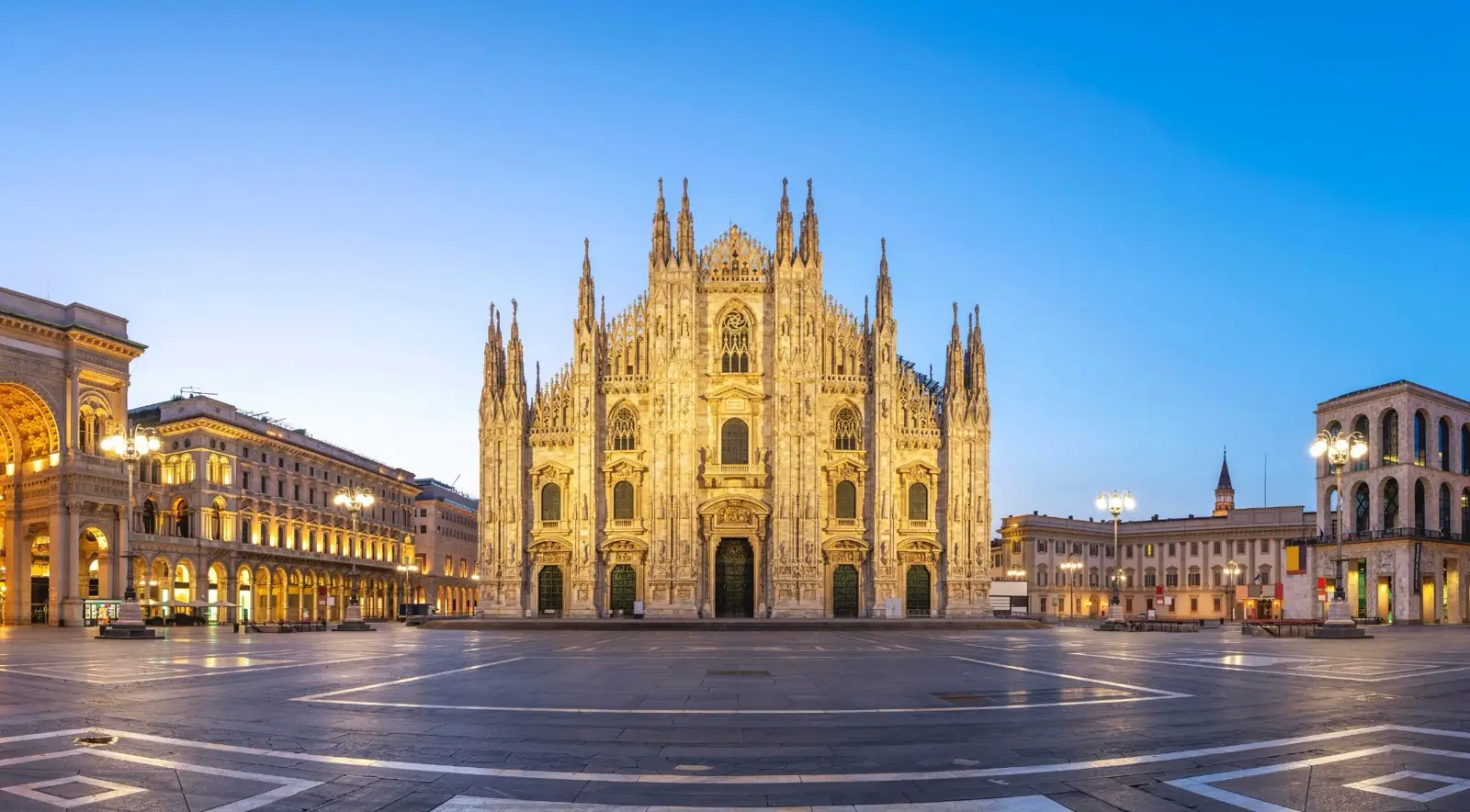
TL;DR
The interior is a five-nave Latin cross of colossal scale — about 148 m long inside, with a central nave vault soaring 45.55 m and 52 marble pillars 24 m tall — the largest church interior in Italy, holding roughly 40,000 people. In walking order, don't miss: the floor Meridian near the entrance, the 55 stained-glass windows, the St. Bartholomew Flayed statue, the Trivulzio Candelabrum, the presbytery with the Holy Nail overhead, Italy's largest organ, and the crypt of St. Charles Borromeo. Plan 45–90 minutes for a respectful, one-way visit.
Interior architecture & dimensions
Built on a Latin-cross plan with five naves — a central nave flanked by two aisles on each side, narrowing to a single nave in the choir.
The most original feature is the monumental capitals decorated with niches holding statues of saints and prophets — the Duomo is frequently cited as the only church in the world with statues carved into its column capitals. The traditional claim that 52 columns represent the 52 weeks of the year is a mnemonic, not documented design intent. The entire floor is inlaid marble designed by Pellegrino Tibaldi from 1584, using pinkish-grey Candoglia, black Varenna and red Verona marble.
Other experiences you might enjoy
After the cathedral interior, most visitors climb to the Duomo rooftop terraces for the view among the spires, cross the square for the Duomo Museum and Archaeological Area, then continue to the Galleria Vittorio Emanuele II next door, Sforza Castle, or across town to see Leonardo da Vinci's Last Supper. The widget below shows live availability for these and other Milan experiences.
A walk-through of the highlights
The Meridian — at the entrance
A thin brass line running across the floor, flanked by marble tiles marking the twelve zodiac signs. Built in 1786 by Brera Observatory astronomers, it's a camera-obscura sundial: a ray of sunlight enters through a gnomon hole about 24 m up and strikes the line at solar noon.
The stained-glass windows
55 monumental stained-glass windows sit within 164 openings, the earliest dating to the late 14th century. The three enormous apse windows behind the altar are the most dramatic — the central one depicts the Vision of the Apocalypse. Best light: south-facing windows catch afternoon sun.
The Trivulzio Candelabrum — north transept
A monumental bronze seven-branched candelabrum about five metres tall, dating from around 1200, credited to an anonymous Anglo-Norman/Rhenish-Meuse master.
St. Bartholomew Flayed — south transept
Carved in 1562 by Marco d'Agrate, this is the interior's single most famous artwork: the apostle stands composed with his own flayed skin draped over his shoulders, celebrated for its anatomical realism. The base bears the inscription "NON ME PRAXITELES SED MARCUS FINXIT AGRATIS." The statue underwent cleaning and restoration into spring 2025, so its detail is sharper than in older photos.
Tombs and monuments
The right transept holds the funerary monument to Gian Giacomo Medici by Leone Leoni (1560–1563), a Renaissance military commander's tomb worth a slow look. The left aisle has the Arcimboldi monument and a group of Visconti sarcophagi — quieter corners most visitors walk straight past.
The two pulpits
Flanking the crossing, twin pulpits are supported by giant bronze caryatid figures by Francesco Brambilla (1585–1599) — some of the cathedral's most sculptural bronze work, easy to miss while looking up at the vault.
The presbytery, high altar & the Holy Nail
Rebuilt by Pellegrino Tibaldi under Carlo Borromeo (1575–1585), with the high altar crowned by a tempietto-shaped tabernacle of Tibaldi's design. The crossing above is covered by the octagonal tiburio, completed 1500–1510 — both Leonardo da Vinci and Donato Bramante submitted competing designs for it in the 1480s. High in the apse vault, a permanent red light marks the tabernacle holding the Holy Nail, believed to be from the True Cross and kept in the Duomo since 1461. Once a year, around 14 September, the Archbishop is raised to retrieve it on the Nivola, a cloud-shaped lift.
The Great Organ
Built in 1938 by Mascioni and Tamburini, described by the Veneranda Fabbrica as the largest organ in Italy, second largest in Europe and seventh largest in the world, with about 15,800 pipes across four monumental wooden cases.
The baptismal font
An ancient Roman basin of red antique porphyry, set in an aedicule designed by Tibaldi around 1580 — distinct from the underground 4th-century Baptistery of San Giovanni alle Fonti beneath the parvis outside, where tradition holds St. Ambrose baptised St. Augustine in 387. See our Duomo Museum & Archaeological Area guide for the full underground site.
The crypt & Scurolo di San Carlo
Beneath the presbytery, the crypt adjoins the octagonal Baroque Scurolo di San Carlo, holding the body of St. Charles Borromeo in a rock-crystal and silver urn — accessible with a small add-on ticket.
The Treasury (Tesoro del Duomo)
Liturgical goldwork spanning the 5th to 17th centuries — including the ivory Diptych of the Five Parts, the Evangeliary of Aribert and the Chiaravalle cross — now largely presented in the Grande Museo del Duomo rather than the nave itself.
Pair the interior with a guide and these details stop being easy to miss. A licensed guide who covers both the interior and the rooftop turns a quiet 45-minute walk into the full 579-year story of the cathedral's construction.
Tickets that cover the interior
If the interior — not the rooftop — is your priority, the direct-entrance ticket is the cheapest way in. For the full nine-ticket breakdown including rooftop combos, see our Milan Duomo tickets guide.
Milan: Cathedral & Duomo's Terraces Entrance Ticket
Cathedral interior, rooftop terraces and Duomo Museum · multilingual audio guide · 4.6 ★ from 71,000+ reviews · valid 2 days.
Cathedral only
Milan Cathedral Direct Entrance — Terrace Excluded
Skip-the-ticket-line access to the nave, stained glass and Gothic vaults if the interior alone is what you're after.
Cathedral + Terraces
Cathedral and Terraces Guided Tour with Tickets
Skip-the-line entry with expert guides who explain the interior's unlabelled highlights, with an optional terrace lift upgrade.
Practical visiting tips
It's a one-way route
Enter via the right-hand tourist entrance on the façade; the visit flows one direction toward the presbytery and exit.
It's an active cathedral
Keep quiet, and expect some areas to close during Mass. Photography is fine for personal use — no flash, tripods or selfie sticks.
No facilities inside
No public toilets, no cloakroom, and large bags, luggage or strollers are not allowed.
Accessibility
Step-free entry via a ramp at the front doors; free loaner wheelchairs and audio guides are available at the Duomo Infopoint.
Brief historical context
Construction began in 1386 under Archbishop Antonio da Saluzzo and Gian Galeazzo Visconti, who granted the newly founded Veneranda Fabbrica del Duomo (1387) exclusive use of Candoglia marble. Built in Gothic style over nearly six centuries — the façade was completed under Napoleon, and the final bronze door was installed in 1965.
Frequently asked questions
What is the most famous artwork inside the Milan Duomo?
The St. Bartholomew Flayed statue (1562, Marco d'Agrate) in the south transept, depicting the apostle standing composed with his own flayed skin draped over his shoulders. It is celebrated for its anatomical realism and is one of the most photographed details inside the cathedral.
How big is the inside of the Milan Duomo?
The interior stretches about 148 metres from entrance to apse, the central nave vault rises 45.55 metres, and the five-nave Latin-cross space holds roughly 40,000 people, supported by 52 pillars each 24 metres tall. It is the largest church interior in Italy.
What is the Holy Nail in the Milan Duomo?
The Santo Chiodo, believed to be a nail from the True Cross, hangs high in the apse vault marked by a permanent red light roughly 45 metres up. It has been kept in the Duomo since 1461 and is retrieved once a year by the Archbishop, raised on a cloud-shaped lift called the Nivola.
When is the Rite of the Nivola in Milan?
During the Triduum of the Holy Nail around 14 September each year, when the Archbishop is raised to the apse vault on the Nivola, a cloud-shaped lift, to retrieve the relic for public veneration. It is a striking, little-known ceremony worth timing a September visit around.
How long does it take to see the inside of the Duomo?
Plan 45–60 minutes for a first-time, respectful walk-through. Art and history enthusiasts should allow 90 minutes or more to find the floor Meridian, study the stained-glass windows, and add the crypt and Scurolo di San Carlo.