TL;DR
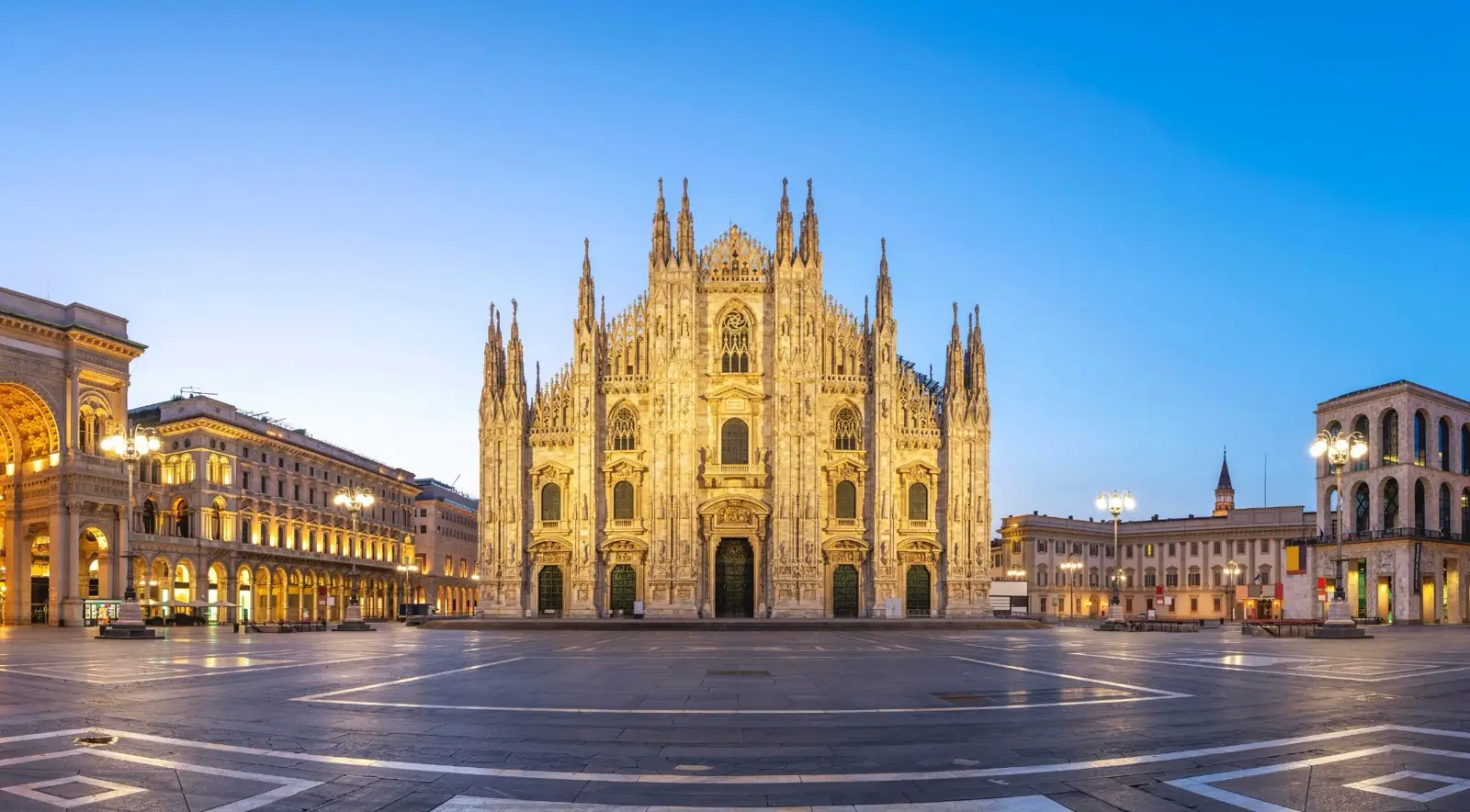
The Duomo di Milano — properly the Cathedral of Santa Maria Nascente — was founded in 1386 under Archbishop Antonio da Saluzzo and the Lord of Milan, Gian Galeazzo Visconti. Its final ornamental details were completed in 1965, making it a nearly 600-year project overseen continuously by the Veneranda Fabbrica del Duomo, founded in 1387 and still working today. Built in white-and-pink Candoglia marble instead of the usual Lombard brick, and in an unusually northern-European Gothic style, it is the largest church in the Italian Republic and among the largest in the world. Britannica records that it "house[s] more statuary than any other building in the world", and it is crowned by 135 spires.
The site had been Milan's Christian heart since Roman times — home to the basilicas of Santa Tecla and Santa Maria Maggiore and the baptistery of San Giovanni alle Fonti, where St. Ambrose baptised St. Augustine in 387. You can still walk through those foundations today: see our Archaeological Area guide.
Before the Duomo: Milan's Christian heart
When Milan was capital of the Western Roman Empire, this square held a cluster of early-Christian buildings: Santa Tecla, the "summer" basilica of about 350–355; Santa Maria Maggiore, the "winter" basilica; and the octagonal Baptistery of San Giovanni alle Fonti, built under St. Ambrose between roughly 378 and 397.
It was here that Ambrose baptised Augustine of Hippo at Easter in 387 — one of the foundational moments of Western Christianity, and the reason the ground under the cathedral matters as much as the building above it.
By the 14th century these churches had decayed. The immediate trigger for everything that followed was mundane: the collapse of Santa Maria Maggiore's bell tower.
The foundation of 1386–1387
Construction began in 1386. Archbishop Antonio da Saluzzo issued a fundraising bull dated 12 May 1386, and the Fabbrica's oldest surviving ledger records income from 23 May 1386 — the earliest hard accounting evidence of the project.
What transformed it from a diocesan rebuild into a dynastic statement was Gian Galeazzo Visconti (1351–1402). In October 1387 he founded the Veneranda Fabbrica del Duomo, the institution that has run the works ever since — for more than 630 years, without interruption.
The new cathedral was dedicated to Santa Maria Nascente, Mary of the Nativity. The high altar, transferred from the old Marian basilica, was consecrated by Pope Martin V on 16 October 1418.
| Date | Event |
|---|---|
| 387 | St. Ambrose baptises St. Augustine at San Giovanni alle Fonti |
| 12 May 1386 | Archbishop Antonio da Saluzzo's founding bull; work begins |
| October 1387 | Gian Galeazzo Visconti founds the Veneranda Fabbrica del Duomo |
| 24 October 1387 | Visconti cedes the Candoglia quarries, toll-exempt |
| 1 May 1392 | The masters vote to build ad triangulum — "as far as the triangle and no further" |
| 1400–1401 | Jean Mignot: "ars sine scientia nihil est" |
| 16 October 1418 | Pope Martin V consecrates the high altar |
| 20 March 1461 | The Holy Nail is transferred from Santa Tecla |
| 1490–1500 | Amadeo and Dolcebuono build the tiburio (keystone 24 September 1500) |
| 1577 | Carlo Borromeo reconsecrates the cathedral |
| 1649 | Carlo Buzzi reverses the façade to a Gothic design |
| 1765–1769 | Francesco Croce builds the Main Spire — 108.5 m |
| 30 December 1774 | The Madonnina is raised |
| 20 May 1805 | Napoleon decrees the façade be finished; largely complete by 1813 |
| 6 January 1965 | Minguzzi's last bronze door inaugurated — the conventional completion |
Other experiences you might enjoy
Six centuries of history are easier to read standing up. The rooftop terraces put you among Croce's spires and the Madonnina; the cathedral interior holds Tibaldi's presbytery and Marco d'Agrate's St. Bartholomew Flayed; and the Duomo Museum keeps the original statuary and the four-metre wooden Modellone of 1519. Beyond the cathedral, Milan's Visconti and Sforza story continues at Sforza Castle, Leonardo's The Last Supper at Santa Maria delle Grazie, the Pinacoteca Ambrosiana, the Galleria Vittorio Emanuele II and the Navigli canals that carried the marble into the city. Guided Duomo history tours, Milan walking tours and rooftop tours all leave from the piazza. The widget below shows live availability for these and other Milan experiences.
Marble and canals: Candoglia and "AUF"
Gian Galeazzo insisted on Candoglia marble rather than brick — a decision that set the building's colour, its cost and its endless maintenance in one stroke. By a decree dated 24 October 1387 he ceded the quarries to the Fabbrica and granted free, toll-exempt transport.
Every block was stamped "AUF" — Ad Usum Fabricae, "for the use of the Fabbrica". The marble travelled entirely by water: from the Toce into Lake Maggiore, down the Ticino, and along the Naviglio Grande into Milan. The route is still symbolically in use, and the quarry is active today, extracting marble exclusively for the Duomo.
Milanese dialect kept the mark: auf came to mean "for free", from the toll exemption stamped on six centuries of stone.
An international Gothic construction site (14th–15th c.)
The first chief engineer, Simone da Orsenigo, planned a brick building in the ordinary Lombard manner. In 1389 the French master Nicolas de Bonaventure gave it its Rayonnant Gothic character — the reason the Duomo looks more like Cologne or Bourges than anything else in Italy. Other masters followed, among them Jean Mignot. The site drew an unprecedented international team of Lombard, French and German masters, and produced two celebrated episodes.
Gabriele Stornaloco and the triangle (1391)
Gabriele Stornaloco, a mathematician, was consulted in 1391 to fix the cross-section and proposed an ad triangulum scheme. At a plenary meeting on 1 May 1392 the masters chose to build "as far as the triangle and no further" — the decision that gave the Duomo its broad, low-shouldered profile rather than the soaring proportions of a French cathedral.
"Ars sine scientia nihil est" (1400–1401)
Jean Mignot condemned the Lombards' work as in pericolo di ruina — in danger of ruin — and declared "ars sine scientia nihil est": "art without science is nothing." The Lombards dismissed his objections. His collapse forecasts proved wrong, but the dispute became a landmark in architectural theory: the first recorded argument between geometric science and practical craft, still cited in the literature (Ackerman's 1949 study of the episode remains the standard account).
The tiburio: Leonardo, Bramante and the Lombard solution (c. 1490–1500)
In the 1480s the Sforza dukes invited Leonardo da Vinci, Donato Bramante, Francesco di Giorgio Martini and others to advise on the tiburio — the lantern tower over the crossing, and the hardest structural problem the building posed.
Their proposals were set aside. In 1490 Ludovico "il Moro" Sforza chose the design of Giovanni Antonio Amadeo and Gian Giacomo Dolcebuono, who built the tiburio between 1490 and 1500, with the keystone placed on 24 September 1500.
Leonardo submitted a design and a model; neither was executed. The tiburio you see from the terraces is Amadeo and Dolcebuono's — a point worth keeping straight, because the "Leonardo designed the Duomo" claim circulates widely and is simply wrong.
The Counter-Reformation interior: the Borromeo era (16th–17th c.)
Under Carlo Borromeo (archbishop 1564–1584) and his cousin Federico Borromeo (1595–1631), the interior was reshaped along Counter-Reformation lines — clearer sightlines to the altar, a liturgy the congregation could see.
Carlo appointed Pellegrino Tibaldi, who rebuilt the presbytery between 1575 and 1585. Borromeo reconsecrated the cathedral in 1577. The same period produced the interior's most famous object: St. Bartholomew Flayed, carved in 1562 by Marco d'Agrate.
Carlo Borromeo is buried in the Crypt of Saint Charles beneath the presbytery — the Scurolo di San Carlo — which keeps its own restricted opening hours. See our opening hours guide before planning a visit to it.
The centuries-long façade debate
Foundations for the front were laid at the end of the 16th century. Francesco Maria Richini and Fabio Mangone built portals in a Baroque idiom up to 1638. In 1649 Carlo Buzzi reversed course entirely, returning to a Gothic design to match the building behind it.
Proposals by Filippo Juvarra (1733) and Luigi Vanvitelli (1745) were never realised. For two centuries the cathedral stood without a finished front — a fact worth holding onto when you look at the façade today, because almost none of what you see is medieval.
The Main Spire and the Madonnina (1765–1774)
The Main Spire was built 1765–1769 by Francesco Croce, bringing the cathedral to 108.5 metres. On top went the Madonnina — sculpted by Giuseppe Perego, executed in gilded copper by Giuseppe Bini, 4.16 metres tall — inaugurated on 30 December 1774. By tradition no building in Milan should rise above her, a convention modern towers honour by mounting a replica Madonnina at their own summit.
She is close enough to photograph from the terraces. Our rooftop & terraces guide covers stairs versus lift and where the best angles on her are.
Napoleon and the completion of the façade (1805–1813)
Preparing to be crowned King of Italy in the Duomo on 26 May 1805, Napoleon was not going to be crowned in front of an unfinished building. By decree of 20 May 1805 — six days before the ceremony — he ordered the façade completed.
Work under Carlo Pellicani, with Zanoia and Amati, proceeded to 1813, following Buzzi's Gothic design rather than inventing a new one. In gratitude, or in flattery, a statue of Napoleon was placed atop one of the spires — where it remains.
The 20th century, WWII and the "final" completion
The great bronze doors were made between 1906 and 1965. The central door is by Ludovico Pogliaghi (1906); the final door, by Luciano Minguzzi, was inaugurated on 6 January 1965 — the conventional completion date for the whole cathedral.
The war
On the night of 15–16 August 1943, bombs seriously damaged the cathedral during the heavy bombing of Milan. The losses were far smaller than they could have been: the stained glass had been preventively removed, and the Madonnina had been draped since August 1939 so her gilding would not catch the light and serve as a navigation mark for bombers. She was unveiled again on 6 May 1945.
The Nivola and the Holy Nail
The cathedral preserves the Santo Chiodo — the Holy Nail, revered as a nail from the True Cross — transferred to the Duomo from Santa Tecla on 20 March 1461. Devotion to it was formalised by Carlo Borromeo during the 1576–77 plague, when he carried it through the city barefoot.
Once a year the Archbishop retrieves the relic aboard the Nivola — a cloud-shaped lift, its current form dating to 1624 — rising to the vault to bring it down for display. It is the one occasion on which a piece of 17th-century stage machinery is still operated as originally intended.
The rite falls in mid-September and restricts access to the nave for several days. Dates and the visitor impact are in our opening hours & best time to visit guide.
Facts & superlatives
| Measure | Figure | Source |
|---|---|---|
| Size | Largest church in the Italian Republic | — |
| External length | 158.50 m | Veneranda Fabbrica |
| Interior capacity | "capable of holding 40,000 visitors" | Veneranda Fabbrica |
| Nave vault height | ~45 m | Veneranda Fabbrica |
| Statues | "over 3,400 statues" | Veneranda Fabbrica |
| Statues | "3,159 images" | Britannica |
| Other sculpture | 150 gargoyles · 96 giants · 410 corbels | Veneranda Fabbrica |
| Spires | 135, tallest crowned by the Madonnina at 108.5 m | Veneranda Fabbrica |
| Material | Built entirely of Candoglia marble | Veneranda Fabbrica |
| Duration | Roughly six centuries (1386–1965) | — |
Britannica's summary is the one worth quoting in full: the Duomo "house[s] more statuary than any other building in the world." Whichever count you accept — 3,159 or 3,400-plus — no other building comes close.
A building that is never finished
The Milanese saying "lungh 'me la fabrica del domm" — "as long as the building of the Duomo" — is used for anything interminable. It is also literally true.
Because Candoglia marble continuously deteriorates, the Veneranda Fabbrica del Duomo has never stopped working. It still runs the quarry, the marble yard and the cathedral worksites, funded by public campaigns such as "Adopt a Spire". Recent interventions include the façade cleaning of 2003–2009 and the tiburio and dome restoration begun in 2016.
So the honest answer to "when was the Duomo finished?" is that the question is malformed. It was begun in 1386, declared complete in 1965, and has been under repair every single day since — and for most of the 579 years in between.
Fast-Track Milan Cathedral and Terraces Guided Tour
Run by the Veneranda Fabbrica itself — the institution Gian Galeazzo Visconti founded in 1387 — so the guide explaining the tiburio works for the body that built it · 4.6 ★ from 5,665 reviews · priority security lane included.
If you would rather have the history explained on the roof, among Croce's spires, or read at your own pace with an audio guide, these are the two alternatives worth comparing:
Cathedral + rooftop, guided
Milan: Duomo Rooftop and Cathedral Guided Tour with Tickets
The strongest-rated guided option on the site. Takes the history up onto the terraces, where the tiburio, the Main Spire and the Madonnina are close enough to argue about — the best setting for the construction story.
Cathedral + terraces + museum, audio guide
Milan: Cathedral and Duomo's Terraces Entrance Ticket
Includes the Duomo Museum, where the original statuary and the four-metre 1519 Modellone are kept — the single best room in Milan for understanding how the thing was actually built. Multilingual audio guide, valid two days.
Where the history is disputed
Popular accounts of the Duomo state several things with more confidence than the record supports. These are the points where careful sources disagree — worth knowing before you repeat any of them.
Founding date: 1386 or 1387?
Both are right about different things. Construction began in 1386; the institutional Fabbrica was founded in 1387.
Completion date
"1965" is a convention. The façade was substantially finished by 1813, and the building is arguably never complete.
Spire and Madonnina dates
The Main Spire is given variously as 1762, 1765–1769 and 1765–1770; the Madonnina as completed 1773 or placed 1774.
Statue and spire counts
"3,400+" (Veneranda Fabbrica) against 3,159 (Britannica); "135 spires" is standard, though 134 and 150 both appear.
Leonardo's tiburio role
He submitted a design and a model, but it was not built. The executed tiburio is by Amadeo and Dolcebuono.
The baptism of Augustine, 387
A strong and early tradition, but the exact spot is traditional rather than archaeologically proven.
Who finished the façade
Variously credited to Pellicani, Zanoia, Amati and Soave — all of whom followed Buzzi's Gothic scheme.
Where these figures come from
Primary authority is the Veneranda Fabbrica (duomomilano.it), with Britannica and the academic literature — Ackerman (1949), Ceriani Sebregondi & Schofield (2016), Grillo (2017) — for the contested points.
Frequently asked questions
How long did it take to build the Milan Duomo?
Roughly six centuries. Construction began in 1386 and the conventional completion date is 6 January 1965, when the last of the bronze doors was inaugurated — about 579 years. Even that date is a convention: the façade was substantially finished by 1813, and because Candoglia marble continuously deteriorates the Veneranda Fabbrica has never stopped working on the building.
Who built the Duomo di Milano?
No single architect. Archbishop Antonio da Saluzzo issued the founding bull dated 12 May 1386, and Gian Galeazzo Visconti, Lord of Milan, drove the project and founded the Veneranda Fabbrica del Duomo in October 1387 to run it. Dozens of masters followed — Simone da Orsenigo, the French Nicolas de Bonaventure, Jean Mignot, Giovanni Antonio Amadeo, Pellegrino Tibaldi, Carlo Buzzi, Francesco Croce and many more — and the Fabbrica has managed the work continuously for over 630 years.
Why is the Milan Duomo built of marble instead of brick?
Because Gian Galeazzo Visconti insisted on it. The first chief engineer, Simone da Orsenigo, had planned a brick building in the usual Lombard manner. By a decree of 24 October 1387 Visconti ceded the Candoglia quarries to the Fabbrica and exempted the marble from all tolls, making white-and-pink Candoglia marble effectively free. Blocks were stamped AUF — Ad Usum Fabricae, for the use of the Fabbrica — and floated down the Toce into Lake Maggiore, down the Ticino and along the Naviglio Grande into Milan.
Did Leonardo da Vinci design the Milan Duomo?
No. In the 1480s the Sforza dukes invited Leonardo da Vinci, Donato Bramante, Francesco di Giorgio Martini and others to propose designs for the tiburio, the lantern tower over the crossing. Leonardo submitted a design and a model, but it was not built. In 1490 Ludovico "il Moro" Sforza chose the scheme of Giovanni Antonio Amadeo and Gian Giacomo Dolcebuono, who built the tiburio between 1490 and 1500.
What does "ars sine scientia nihil est" mean and why is it associated with the Duomo?
It means "art without science is nothing". The French master Jean Mignot said it in 1400–1401 during a dispute with the Lombard masters, whose work he condemned as in pericolo di ruina — in danger of ruin. The Lombards dismissed his objections and his collapse forecasts proved wrong, but the exchange became a landmark in architectural theory as the first recorded argument between geometric theory and practical building.
What is the Madonnina on top of the Milan Duomo?
A gilded copper statue of the Virgin Mary, 4.16 metres tall, sculpted by Giuseppe Perego with the copper work by Giuseppe Bini, and inaugurated on 30 December 1774. She stands on the Main Spire built by Francesco Croce between 1765 and 1769, which brings the cathedral to 108.5 metres. By Milanese tradition no building in the city should rise above her.
Why did Napoleon finish the Duomo's façade?
Because he was about to be crowned King of Italy inside it. The cathedral had stood without a finished front for two centuries. Napoleon's coronation was set for 26 May 1805, and by a decree of 20 May 1805 he ordered the façade completed. Work under Carlo Pellicani, with Zanoia and Amati, ran to 1813 and followed Carlo Buzzi's 1649 Gothic design. A statue of Napoleon was placed on one of the spires.
Was the Milan Duomo damaged in the Second World War?
Yes. Milan was heavily bombed on the night of 15–16 August 1943 and the cathedral was seriously damaged. The losses were far smaller than they could have been because the stained glass had been removed preventively, and the Madonnina had been draped since August 1939 so her gilding would not catch the light and guide bombers. She was unveiled again on 6 May 1945.
How many statues and spires does the Milan Duomo have?
Sources differ. The Veneranda Fabbrica cites over 3,400 statues, plus 150 gargoyles, 96 giants and 410 corbels; Britannica gives 3,159 images and says the cathedral houses more statuary than any other building in the world. The spire count is conventionally 135, though 134 and 150 occasionally appear. The tallest spire is crowned by the Madonnina at 108.5 metres.
Is the Milan Duomo finished?
Not really, and the Milanese have a saying for it: lungh 'me la fabrica del domm — "as long as the building of the Duomo". Candoglia marble deteriorates continuously, so the Veneranda Fabbrica still runs the quarry, the marble yard and the cathedral worksites, funded by campaigns such as "Adopt a Spire". Recent work includes the façade cleaning of 2003–2009 and the tiburio and dome restoration begun in 2016.