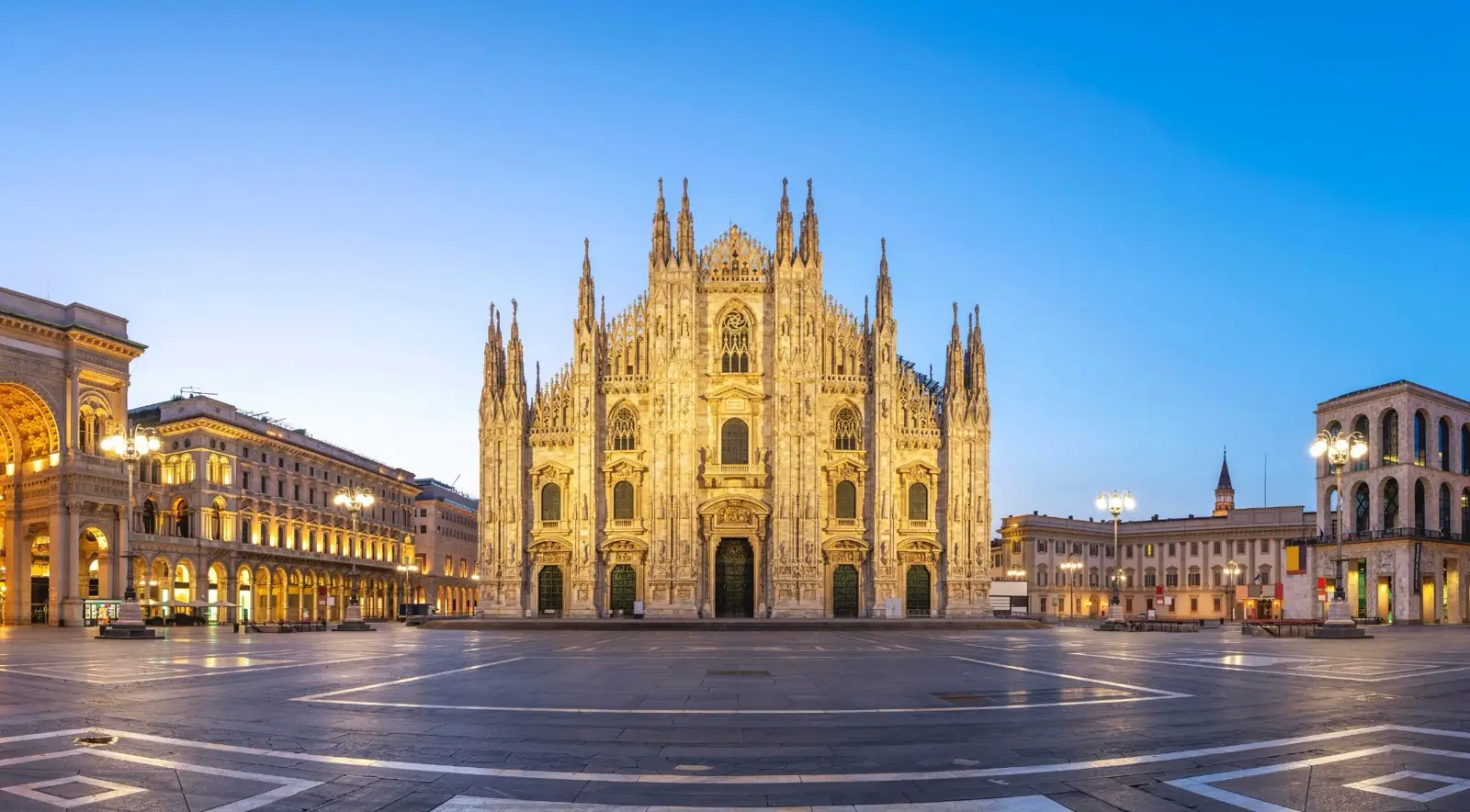
TL;DR
The Galleria Vittorio Emanuele II is a monumental 19th-century shopping arcade beside the Duomo — a glass-and-iron-roofed, cross-shaped gallery opened in 1867 and named for Victor Emmanuel II, the first king of a unified Italy. It is free to walk through, open 24/7, and connects Piazza del Duomo to Piazza della Scala. Inside you'll find the historic Prada flagship, Louis Vuitton, luxury boutiques, historic cafés, and the famous bull mosaic where visitors spin their heel for good luck.
Often called "il Salotto di Milano" — Milan's drawing room — it is one of the world's oldest shopping galleries and an essential 15–30 minute stop that pairs naturally with a Duomo visit.
What it is and why it matters
The Galleria Vittorio Emanuele II is a covered commercial arcade linking Piazza del Duomo with Piazza della Scala. Roofed in glass and iron in the grand 19th-century manner, it functions as three things at once: a covered street, a luxury shopping destination, and a monument to the newly unified Italy.
It is one of the oldest shopping arcades in the world and remains the beating retail and social heart of central Milan — which is why the Milanese nickname it "il Salotto di Milano", the city's drawing room. You do not visit it so much as pass through it, repeatedly, over the course of any few days in Milan.
History and architecture
Conceived as part of the redevelopment of the area around the Duomo after Italian unification, the Galleria was designed by Giuseppe Mengoni and constructed between 1865 and 1867, with the triumphal arch toward the Duomo and finishing works continuing into the 1870s.
The structure is built as a Latin cross of two glass-vaulted arcades meeting at a central octagon crowned by a glass dome rising roughly 47 metres. The engineering — iron ribs supporting vast panels of glass — was cutting-edge for its era and influenced later arcades and shopping galleries worldwide.
In a famous tragedy, Mengoni died after falling from the scaffolding in 1877, shortly before the arcade's grand inauguration. He never saw the finished building.
The Galleria was named in honour of Victor Emmanuel II (Vittorio Emanuele II), the first king of a united Italy, and the space is decorated throughout with patriotic and allegorical detail celebrating the nation and its cities.
The same decades produced the Duomo's own long-delayed façade and Napoleon-era completion — our history of the Milan Duomo covers how the cathedral and the city around it were finished in step.
Other experiences you might enjoy
The Galleria is free, so nothing here is a ticket — it's a hinge between the things that are. Walk in from the Duomo and out the far end and you are at Piazza della Scala and the Teatro alla Scala opera house; a few minutes further sit Sforza Castle, the Pinacoteca di Brera and the Brera district. Leonardo da Vinci's The Last Supper at Santa Maria delle Grazie is a short metro ride west. Guided Milan walking tours almost all route through this arcade, and e-bike tours, hop-on hop-off buses, Navigli canal cruises and Brera food tours start within a few minutes of the piazza. The widget below shows live availability for these and other Milan experiences.
The mosaics and the lucky bull
The floor and the octagon are richly decorated with mosaics, including personifications of the continents and the coats of arms of the cities that served as capitals of the Kingdom of Italy: Turin, Florence, Rome and Milan.
The most famous is the bull of Turin. Local tradition holds that placing your heel on the bull and spinning around three times brings good luck — and, some say, ensures a return to Milan. So many visitors have done it that a hollow has worn into the mosaic, which is periodically restored.
Expect a short queue at the bull in daylight hours, and expect to look faintly ridiculous. Both are part of the deal.
Shopping, cafés and dining
The Galleria houses flagship luxury boutiques and historic establishments — and retail rents here are among the highest in the world, which tells you most of what you need to know about the pricing inside.
- Prada — the historic flagship opened here in 1913, the store from which the fashion house grew.
- Louis Vuitton, Versace, Gucci and other luxury houses.
- Historic cafés and restaurants — including long-established spots for coffee, aperitivo and fine dining, plus the celebrated Camparino bar associated with the birthplace of Campari aperitivo culture.
- The seven-star Galleria Vittorio Emanuele II hotel (TownHouse Galleria) occupies part of the upper floors.
Practical information
| Detail | What to know |
|---|---|
| Cost | Free to enter and walk through |
| Hours | A public passage — effectively open 24 hours. Shops typically ~10:00–20:00; cafés later |
| Location | Directly off Piazza del Duomo, adjacent to the cathedral; the far end opens onto Piazza della Scala |
| Getting there | Metro Duomo (M1/M3); enter through the triumphal arch on the Piazza del Duomo side |
| How long to spend | 15–30 minutes for the dome, mosaics and windows; longer for shopping, dining or the bull ritual |
| Best time | Early morning or evening for atmospheric light and thinner crowds |
| Rainy day | Ideal — the covered glass roof makes it a natural wet-weather stop |
The glass dome is spectacular on sunny days and beautifully lit at night, so the arcade rewards a second pass at a different hour rather than one long visit.
The Highline Galleria rooftop walkway
A paid "Highline Galleria" rooftop walkway experience has at times operated across the glass roofs, offering close-up views of the dome and panoramas toward the Duomo. Availability varies — it has run intermittently rather than continuously, and it is not currently sold through the booking channels this site uses. Check whether it is operating before building a plan around it.
If it is closed, the cathedral's own rooftop terraces are the reliable way to get above the piazza — and they look down onto the Galleria's roof anyway.
How it fits with a Duomo visit
The Galleria is the natural next step after the cathedral: exit onto Piazza del Duomo, walk through the triumphal arch into the arcade, admire the octagon and dome, spin on the bull, and continue to Piazza della Scala and the Teatro alla Scala at the far end — an easy, free, five-minute stroll linking three of Milan's landmarks.
Because it costs nothing and never closes, it is also the best filler in central Milan: the thing to do while you wait out a timed Duomo slot, a rain shower, or the gap before an aperitivo.
Most guided city walks route through the arcade rather than around it. These three genuinely enter it — we checked each itinerary rather than trusting the search results:
City walk + Last Supper ticket
Milan: Guided Walking Tour & Last Supper Visit with Ticket
Walks Via Dante and Piazza dei Mercanti, stops at the 1776 La Scala theatre, then enters the glass-roofed Galleria to explain the 19th-century engineering, and ends in front of the Duomo. The Last Supper ticket is the real prize — those sell out months ahead independently.
Duomo + Last Supper + city centre
Milan: Guided Duomo, Last Supper and City Centre Tour
Comes to the Galleria straight out of Santa Maria delle Grazie and treats it as a stop in its own right — "a building that looks more like a baroque palace" — then passes Sforza Castle and La Scala. A smaller review base than the tour above.
E-bike, historic + modern city
Milan: Highlights and Hidden Gems E-Bike Tour
Cycles through the Vittorio Emanuele Gallery and Sempione Park, taking in the Vertical Forest towers as well as the old town — the option that covers the most ground for the least money, and the only one here that isn't Last-Supper-led.
None of these is required to see the Galleria — it is free and always open. They are worth it only if you want the wider city walk; our guide to Milan's guided, walking and self-guided tours compares the formats properly.
What we'd actually do
- Pair it with the Duomo — walk through immediately before or after your cathedral visit. It's steps away and free.
- Look up. The central octagon, glass dome and mosaic floor are the highlights; don't rush straight through to the shops.
- Do the bull ritual for a fun photo, then continue to Piazza della Scala.
- Time it for light — sunny midday for the glass dome, or evening for the illuminated arcade and aperitivo hour at a historic café.
- Budget accordingly. Window-shopping and people-watching are free; food, drink and shopping here carry a premium for the prestige address.
- Rainy-day pick — the covered glass roof makes it a perfect wet-weather stop between other central sights.
Before you go — the fine print
Shop hours vary; the passage doesn't
Individual shop and café hours change seasonally. Only the arcade passage itself is effectively always open.
The rooftop walkway is intermittent
The Highline Galleria and similar paid experiences operate on and off — check current availability before planning around them.
Café prices reflect the address
Prices inside are notably higher than elsewhere in Milan. A coffee standing at the bar is the cheap way to sit in the room.
Some figures vary between sources
The dome height (~47 m) and the completion dates (1867 vs 1877) differ slightly source to source: the arcade opened in 1867, with decorative work continuing into the later 1870s.
Frequently asked questions
Is the Galleria Vittorio Emanuele II free to visit?
Yes. The arcade is a public passage — free to enter and walk through, with no ticket of any kind. Only what you buy inside costs money, and prices at the cafés, restaurants and boutiques are notably higher than elsewhere in Milan, reflecting the address.
What are the Galleria Vittorio Emanuele II opening hours?
The arcade itself is effectively open 24 hours, because it is a covered public street rather than a building you enter. Individual shops, cafés and restaurants keep their own hours — typically around 10:00 to 20:00 for shops, later for cafés.
What is the bull mosaic in the Galleria and what do you do with it?
It is the bull of Turin, part of the mosaic floor under the central octagon showing the coats of arms of the cities that served as capitals of the Kingdom of Italy — Turin, Florence, Rome and Milan. Local tradition holds that placing your heel on the bull and spinning around three times brings good luck, and some say it guarantees a return to Milan. So many visitors have done it that a hollow has worn into the mosaic, which is periodically restored.
Who designed the Galleria Vittorio Emanuele II?
The architect Giuseppe Mengoni, who built it between 1865 and 1867 with finishing work continuing into the 1870s. In a famous tragedy Mengoni fell to his death from the scaffolding in 1877, days before the official inauguration.
Why is it called the Galleria Vittorio Emanuele II?
It is named in honour of Victor Emmanuel II, the first king of the Kingdom of Italy, proclaimed in 1861. The arcade was conceived as part of the redevelopment around the Duomo after Italian unification, and is decorated throughout with patriotic and allegorical detail celebrating the new nation and its cities.
How long should you spend in the Galleria Vittorio Emanuele II?
About 15 to 30 minutes to walk through and take in the dome, the mosaics and the shop windows — longer if you are shopping, stopping for a coffee or an aperitivo, or queuing for the bull ritual. It is a stop, not a half-day.
How high is the Galleria's glass dome?
Roughly 47 metres, over the central octagon where the two glass-vaulted arcades cross. The iron-ribbed structure supporting those vast glass panels was cutting-edge engineering for its era and influenced arcades and shopping galleries worldwide.
What shops are in the Galleria Vittorio Emanuele II?
The historic Prada flagship, which opened here in 1913 and is the store the fashion house grew from, plus Louis Vuitton, Versace, Gucci and other luxury houses. There are long-established cafés and restaurants including the celebrated Camparino, associated with the birth of Campari aperitivo culture, and the seven-star TownHouse Galleria hotel occupies part of the upper floors. Retail rents here are among the highest in the world.
How do you get to the Galleria Vittorio Emanuele II?
Metro Duomo on lines M1 and M3 puts you on Piazza del Duomo; you enter through the triumphal arch on the piazza side, directly beside the cathedral. The far end opens onto Piazza della Scala.
Can you walk on the Galleria's roof?
Sometimes. A paid Highline Galleria rooftop walkway experience has at times operated across the glass roofs, giving close-up views of the dome and panoramas toward the Duomo, but availability varies and it runs intermittently. Check whether it is currently operating before planning around it — it is not a fixture like the cathedral's own terraces.