TL;DR
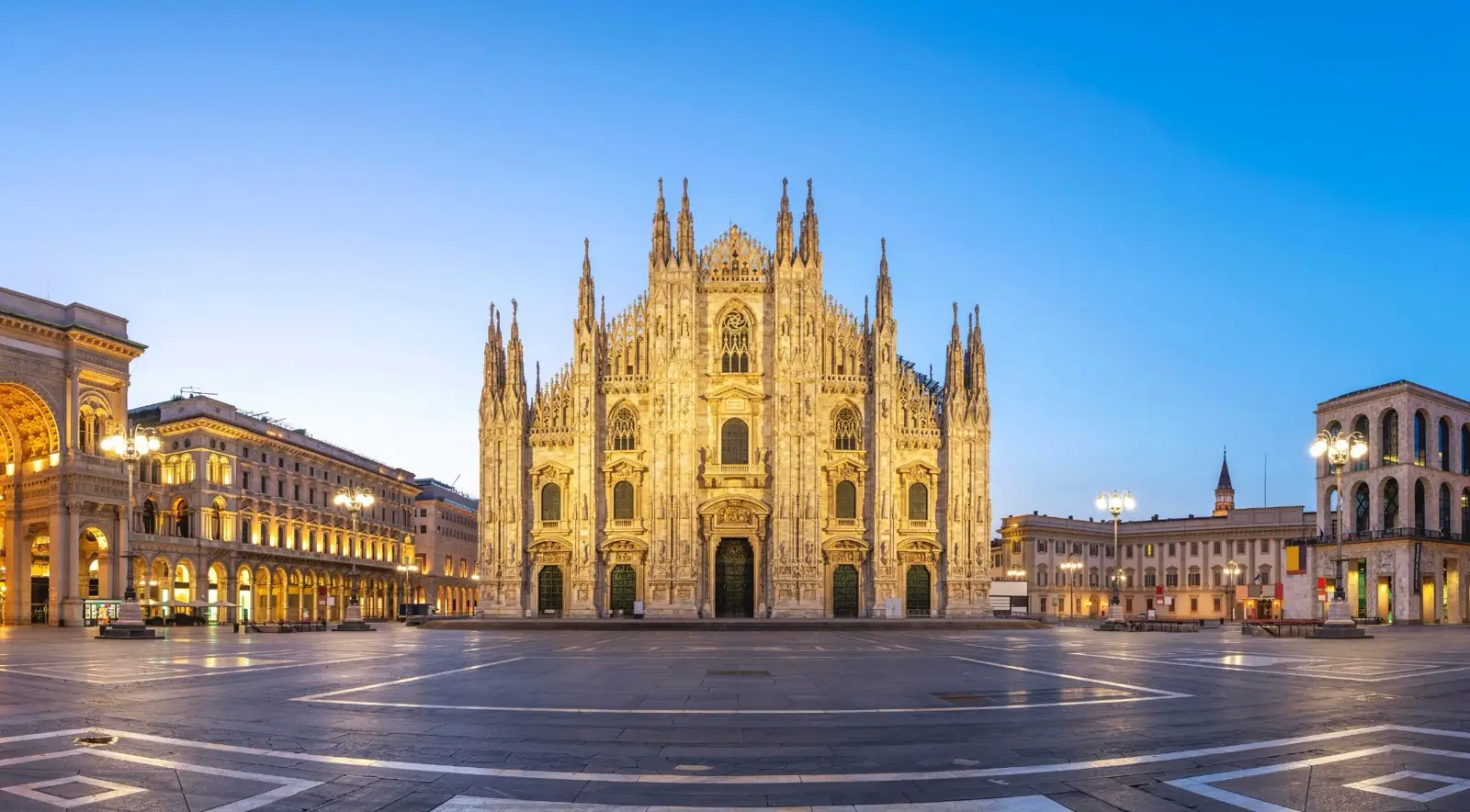
The Duomo di Milano is the Gothic cathedral at the heart of Milan — the largest church in the Italian Republic, built over nearly six centuries (1386–1965) in white-pink Candoglia marble, and crowned by 135 spires and the golden Madonnina at 108.5 metres. The unmissable experiences are the rooftop terraces (walk among the spires), the vast interior (52 pillars, the St. Bartholomew statue, the Holy Nail), the Duomo Museum, and the underground archaeological area.
Tickets run from €10 (interior + museum) to €32 (fast-track all-access). Book online at ticket.duomomilano.it, go early on a weekday, dress with shoulders and knees covered, and allow 2–4 hours for the full complex.
What is the Duomo di Milano?
The Cathedral of Santa Maria Nascente — universally known as the Duomo di Milano — is the seat of the Archbishop of Milan and the city's defining monument, standing at the exact centre of Milan on Piazza del Duomo.
It is the largest church in the Italian Republic (St. Peter's is in Vatican City), one of the largest cathedrals in the world, and holds up to 40,000 people. Built almost entirely of Candoglia marble in an unusually northern, spiky Gothic style, it is famous for having more exterior statuary than virtually any other building on earth — more than 3,400 statues, 135 spires, 150 gargoyles and 96 giants.
This guide is your starting point; each section links to a detailed article on tickets, the rooftop, the interior, the Last Supper nearby, and more.
The essentials at a glance
| Detail | Figure |
|---|---|
| What | Gothic Roman Catholic cathedral, dedicated to St. Mary of the Nativity |
| Where | Piazza del Duomo, central Milan (Metro Duomo, M1/M3) |
| Built | 1386–1965 (nearly 600 years); run by the Veneranda Fabbrica del Duomo, founded 1387 |
| Height | 108.5 m to the Madonnina atop the main spire |
| Size | ~158 m long; largest church in Italy |
| Material | Candoglia marble, floated to Milan via the Navigli canals |
| Hours | Cathedral & terraces daily 09:00–19:00; museum 10:00–19:00, closed Wednesdays |
| Tickets | From €10 (interior + museum) to €32 (fast-track all-access) |
| Time to allow | 2–4 hours for the full complex |
Other experiences you might enjoy
The cathedral anchors a compact centre where almost everything is walkable. Straight off the piazza sits the free, glass-roofed Galleria Vittorio Emanuele II, which leads to Piazza della Scala and the Teatro alla Scala. A little further are Sforza Castle, the Pinacoteca di Brera, the Pinacoteca Ambrosiana and the Navigli canals that carried the cathedral's marble into the city. Leonardo da Vinci's The Last Supper at Santa Maria delle Grazie is a short metro ride west and runs its own scarce timed-ticket system. Guided Duomo and rooftop tours, Milan walking tours, e-bike tours, hop-on hop-off buses and Brera food tours all start within minutes of the square. The widget below shows live availability for these and other Milan experiences.
What to see
The rooftop terraces
The single best thing to do at the Duomo — and unique in the world of Gothic cathedrals — is to walk across the roof. You climb 251 steps or take a lift to the first level, then stroll marble walkways among the forest of 135 spires and thousands of statues, right up to the base of the golden Madonnina, with views over Milan to the Alps on clear days. See our full rooftop & terraces guide.
The interior
Beyond the doors lies one of Europe's grandest Gothic interiors: five naves divided by 52 towering pillars, 55 monumental stained-glass windows, the macabre 1562 statue of St. Bartholomew carrying his own flayed skin, Italy's largest organ (~15,800 pipes), a 1786 floor meridian, and — high in the apse, marked by a red light — the Holy Nail relic. See our full interior guide.
The Duomo Museum & archaeological area
Across the square in Palazzo Reale, the Grande Museo del Duomo displays the cathedral's original statues, stained glass, tapestries and Treasury goldwork, plus the great wooden scale model. Beneath the cathedral, the archaeological area preserves the 4th-century Baptistery of San Giovanni alle Fonti, where St. Ambrose baptised St. Augustine in 387. See our full museum & archaeology guide.
The crypt & Scurolo di San Carlo
Below the high altar lie the circular winter choir and the octagonal Baroque Scurolo, where the body of St. Charles Borromeo rests in a rock-crystal and silver urn. A dedicated crypt guide is still to come on this site; in the meantime, its restricted opening hours are set out in our opening hours guide and its €3.50 add-on price in our entrance fees breakdown.
A brief history
Construction began in 1386 under Archbishop Antonio da Saluzzo and Gian Galeazzo Visconti, who founded the Veneranda Fabbrica in 1387 and reserved the Candoglia marble quarries for the cathedral forever.
An international team of Lombard, French and German masters built it over centuries in Gothic style; the tiburio (crossing tower) was completed around 1500 after a debate involving Leonardo and Bramante. The main spire and Madonnina were raised in the 1760s–1774; Napoleon pushed the façade to completion for his 1805 coronation as King of Italy; and the last bronze door was inaugurated in 1965.
Because the marble constantly needs renewing, the Fabbrica has never stopped working — hence the Milanese saying "as long as the building of the Duomo." See our full history article.
Planning your visit
Tickets and prices (2026)
| Ticket | Price |
|---|---|
| Duomo + Museum | €10 / €5 reduced (€8 on Wednesdays) |
| Combo — cathedral + rooftop + museum | €22 stairs / €26 lift |
| Culture Pass (adds archaeological area + crypt) | €15 |
| Fast-Track all-access | €32 |
| Rooftops only | €16 stairs / €18 lift · on GetYourGuide from $22, 4.5 · 8,968 reviews |
Buy at ticket.duomomilano.it (no booking fees since April 2025) or authorised resellers GetYourGuide and Tiqets. See our full tickets guide and prices breakdown.
The €32 Fast-Track pass is the top of the Duomo's own range. One product goes higher: the two-site Duomo + Ambrosiana combo at €36, which adds the Pinacoteca Ambrosiana and the Crypt of San Sepolcro on a 72-hour ticket.
Opening hours & best time to visit
Open daily; cathedral and terraces 09:00–19:00, museum 10:00–19:00 (closed Wednesdays). Visit early on a weekday — not Wednesday if you want the museum — or late afternoon, ideally in April–May or September–October. Summer terraces stay open to 20:00 on Fri–Sun (5 June – 13 September 2026). See our full hours & best-time guide.
Dress code
Shoulders and knees must be covered for everyone; hats off inside. Enforced at security — carry a scarf. See our full dress code guide.
Getting there
Metro Duomo station sits directly under the piazza, served by M1 (red) and M3 (yellow); many trams and buses stop nearby. A dedicated transport guide is still to come on this site.
Milan: Cathedral & Duomo's Terraces Entrance Ticket
The Veneranda Fabbrica's own all-areas product — cathedral, rooftop terraces and Duomo Museum on one timed booking · multilingual audio guide · 4.6 ★ from 71,000+ reviews · valid 2 days.
If you'd rather not assemble the visit yourself, these two cover the opposite ends of the range — cheapest way in, and a guided visit with the security queue handled:
Cathedral only, terrace excluded
Milan Cathedral Direct Entrance — Terrace Excluded
The entry-level option, matching the €10 official tier, with the Duomo Museum, archaeological area and Crypt of Saint Charles all available as add-ons at checkout — the cheapest route to the underground Baptistery.
Cathedral + terraces, fast-track
Fast-Track Milan Cathedral and Terraces Guided Tour
Run by the Veneranda Fabbrica itself, with the priority security lane included — which also means a guide spots a dress-code problem before you reach the barrier rather than at it.
Nearby: the classic Milan day
The Duomo pairs perfectly with the adjacent Galleria Vittorio Emanuele II — a free glass-roofed arcade — Piazza della Scala and the La Scala opera house, the Sforza Castle, and, a short walk or metro ride away, Leonardo's Last Supper at Santa Maria delle Grazie, which must be booked months ahead.
See our Last Supper tickets guide for how its timed-reservation system works. A dedicated Milan itinerary guide is still to come on this site.
What we'd actually do
- Book online in advance, choosing the Combo Stairs (€22) for the best value or Combo Lift (€26) if you'd rather not climb.
- Go early — the 09:00 opening slot on a Tuesday–Friday is quietest. Do the rooftop first, then the interior.
- Dress correctly — shoulders and knees covered — to avoid being turned away.
- Allow 2–4 hours for the full complex; add the museum and archaeological area with the Culture Pass or a combo.
- Plan the Last Supper separately and early — it's a different site with its own scarce timed tickets.
- Thresholds: peak-season weekend or midday → consider Fast-Track (€32); limited time → interior + rooftop only; love art and history → add the museum, archaeological area and crypt.
Before you go — the fine print
- Prices, hours and special openings change — confirm on duomomilano.it before your visit and buy only from official or authorised channels.
- The Duomo Museum and San Gottardo close Wednesdays; the Crypt of St. Charles closes Sundays and religious festivals.
- Some statistics vary between sources — statue counts, exact heights and dates. This guide uses the Veneranda Fabbrica's official figures where available.
- The lift reaches only the first rooftop level; everyone descends by stairs.
Frequently asked questions
What is the Duomo di Milano?
The Cathedral of Santa Maria Nascente — universally known as the Duomo di Milano — is the seat of the Archbishop of Milan and the city's defining monument, standing at the exact centre of Milan on Piazza del Duomo. It is the largest church in the Italian Republic (St Peter's is in Vatican City), one of the largest cathedrals in the world, and holds up to 40,000 people. Built almost entirely of Candoglia marble in an unusually northern, spiky Gothic style, it has more exterior statuary than virtually any other building on earth.
How big is the Milan Duomo?
About 158 metres long, 108.5 metres tall to the Madonnina on the main spire, and large enough to hold up to 40,000 people. It carries more than 3,400 statues, 135 spires, 150 gargoyles and 96 giants, and it is the largest church in the Italian Republic.
How long did it take to build the Milan Duomo?
Nearly six centuries. Construction began in 1386 under Archbishop Antonio da Saluzzo and Gian Galeazzo Visconti, who founded the Veneranda Fabbrica del Duomo in 1387 to run the works, and the last bronze door was inaugurated in 1965. Because the Candoglia marble constantly needs renewing, the Fabbrica has never stopped working — hence the Milanese saying "as long as the building of the Duomo".
How much does it cost to visit the Duomo di Milano?
From €10 for the cathedral interior plus the Duomo Museum, or €8 on Wednesdays when the museum is closed. The combined cathedral, rooftop and museum ticket is €22 by stairs or €26 by lift; the Culture Pass, which adds the archaeological area and crypt, is €15; and the Fast-Track all-access ticket is €32. The two-site Duomo + Ambrosiana combo tops the range at €36.
How long should you allow for the Milan Duomo?
Two to four hours for the full complex. The cathedral interior alone takes about 45 to 60 minutes; adding the rooftop terraces brings it to roughly 1.5 to 2 hours; the museum and archaeological area push it to 2.5 to 4 hours.
What is the best time to visit the Duomo di Milano?
Early on a weekday — the 09:00 opening slot, Tuesday to Friday — or late afternoon, ideally in April to May or September to October. Avoid Wednesday if you want the Duomo Museum, which closes that day. In summer the terraces stay open until 20:00 on Fridays to Sundays from 5 June to 13 September 2026.
What is the dress code at the Duomo di Milano?
Shoulders and knees must be covered, for everyone, and hats come off inside. It is enforced at the security check before you enter, it applies to the rooftop terraces as well as the nave, and a timed ticket is generally not refunded if you are turned away. Carry a scarf.
How do you get to the Duomo di Milano?
Metro Duomo station sits directly under the piazza, served by M1 (red) and M3 (yellow). Many trams and buses also stop nearby, and the cathedral is a short walk from Milan's central shopping and museum district.
Is the Milan Duomo rooftop worth it?
It is the single best thing to do at the Duomo and unique among Gothic cathedrals — you walk across the roof itself. Climb 251 steps or take the lift to the first level, then stroll marble walkways among the 135 spires and thousands of statues right up to the base of the Madonnina, with views over Milan to the Alps on clear days. The lift reaches only the first level, and everyone descends on foot.
What is there to see near the Duomo di Milano?
The adjacent Galleria Vittorio Emanuele II, a free glass-roofed arcade, opens straight off the piazza and leads to Piazza della Scala and the La Scala opera house. Sforza Castle is a short walk further, and Leonardo's Last Supper at Santa Maria delle Grazie is a short walk or metro ride away — though it must be booked months ahead.